Search

Loyal cardiologist returns to Maspeth

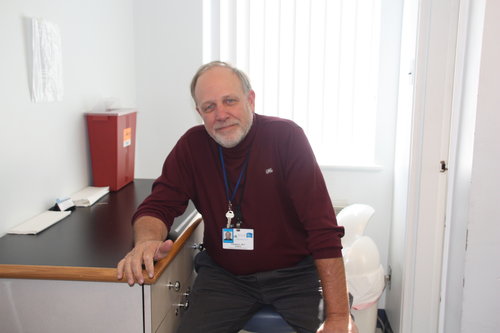
Doctor Gregory Gustafson recently returned to doing what he loves the most, caring for the hearts of Maspeth.
After opening New York Hospital of Queens’ first cardiac catheterization lab in 1994, Gustafson saw patients there for several years, but was exposed to excessive amounts of radiation.
So in 2010 he opened an office in Maspeth and spent one morning a week seeing patients in the community. However, the private practice there closed and Gustafson went back to working at the hospital as a full-time teacher.
Now he’s happily back.
“Maspeth, in the middle of a city, has this almost village-like feel,” he said in an interview last Friday in his office at 72-41 Grand Avenue. “I really, really love the personal involvement of getting to know people’s families, husbands and wives come in, daughters bring in their mothers.”
He said at the hospital, he never met 90 percent of his patients before they came in for treatment, or ever saw them again.
But in Maspeth, Gustafson can perform what medicine is really about, he said.
“Care of the soul, it’s understanding people’s lives and needs and helping them to cope with all those things and identifying the emotional issues and the medical issues that you can help them with, either by counseling them or by deciding what kind of treatments might be useful for them,” Gustafson said.
“It can be stress-related chest pain or it could be somebody who’s really about to have a heart attack that you really have to move fast on,” he added. “And you have to have the knowledge and the experience to give them counsel, have them trust you, so you can lead them to a better place where they’re not feeling so bad.”
Gustafson grew up in the hill country of northwest New Jersey, in a town of about 500 people, which is part of the reason why he feels so comfortable in Maspeth, he said.
In the beginning of his career, while practicing in Manhattan, he worked with an innovative group if invasive cardiologists, who were among the first perform invasive cardiac procedures for the purpose of assessing coronary artery disease.
Invasive cardiology wasn’t a common procedure until the late 1970s, after a wave of heart disease swept through the United States.
“Everybody was afraid to get near the heart, to touch the heart, and certainly no one was going to put something down a coronary artery to see what it looked like,” Gustafson said. “Everybody just assumed that if you did something like that, you’d kill the patient on the spot.”
Now, operative techniques that are done through catheters on a video screen as opposed to open heart surgery are used regularly.
But Gustafson said his time in the innovative world of medicine is behind him, and he’s happy doing cardiac consultations for residents of Maspeth and surrounding areas.
His private practice includes managing high blood pressure and other heart problems, previous heart attacks, bypass surgery survivors, those with irregular heart rhythms, or younger people who are looking to prevent heart problems, he said.
Although he still spends most of his time at the hospital, Gustafson makes himself available to his Maspeth patients, as many of them call his cell phone to reach him.
“I love it here,” he said. “I love my job, I love my work.”

Audits highlight faulty property values

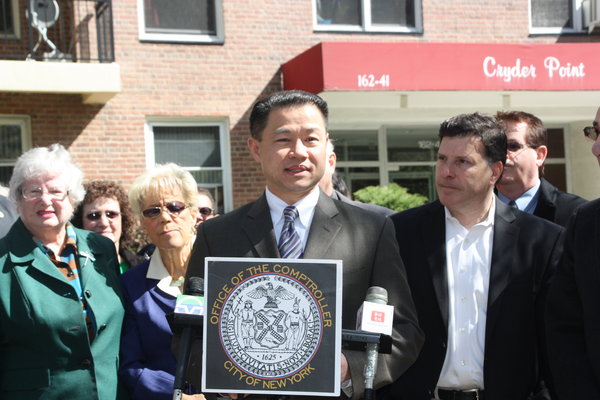
A series of audits conducted by Comptroller John Liu’s office recently found that the Department of Finance, in some cases, arbitrarily assigns property assessments, sending co-op and condo owners on a financial roller coaster.
According to Liu’s office, the Finance Department (DOF) failed to tell homeowners of a change in its property assessment method in Fiscal Year 2011/12, which resulted in an uptick in property taxes while home costs were stagnant.
At a press conference last week in front of the Cryder Point houses on Powell’s Cove Boulevard, speakers charged that DOF officials can change assessment numbers by hand in the department’s computer system, sometimes resulting in errors.
The tentative assessment for Cryder Point rose 51 percent last year before it was corrected, Liu said.
Speakers at the conference called for more transparency for the public to see what their property values are based on, but Liu said DOF is so far only responsive to some of the audit’s suggestions.
“Homeowners shouldn’t have to stress over wild, unexpected, inexplicable swings in their property assessments and taxes,” he said.
While taxes rose 12 percent citywide last year, some co-op owners saw an average 32 percent increase in market values, according to one of the audits.
In addition, DOF did not yet explain why 10 percent of the 859 co-op buildings in Queens received higher property values than the department’s assessment formula should have allowed, the audit states.
The other audit found faulty decisions in the department’s assessments, such as comparing the value of a Brooklyn co-op to a parking lot, and assessing the value of a condominium building in Flushing by comparing it to a rental property in Far Rockaway.
However, a DOF representative countered that the “department works each year to assess more than one million properties transparently and accurately. We continue to work with New Yorkers throughout that process.”
The audits followed the introduction of two bills by state representatives that aim to keep co-ops and condominiums from paying excessive legal fees when challenging a tax assessment, as well as to stabilize assessments for two years after a challenge is won.
State Senator Toby Ann Stavisky and Assemblyman Edward Braunstein introduced the bills in March after co-ops in Bay Terrace spent $37,000 in legal fees to successfully fight last year’s assessment. As a result of the challenge, the city reduced the assessment to $11.8 million, only to raise it back to $15.3 million in January for the 2012/13 tax season.
In addition, the president’s Co-op and Condo Council recently approved a bill introduced by State Senator Tony Avella which would work to create a new property tax class, Class One A, for co-op and condo owners by capping yearly taxes at 6 percent, and 20 percent over a five year period.
“But it shouldn’t be up to these complaints and electeds getting involved, the Finance Department should have gotten it right in the first place,” Liu said.
Stavisky, who lives in a Bay Terrace co-op, said last week that residents in the area are middle class and can’t afford to keep up with drastically fluctuating taxes.
“What to me makes it worse is that the shareholders throughout the city of New York have lost confidence in the Department of Finance and the integrity of the process, and that to me, long-term, is a serious problem with the co-ops and condos,” she said.

104th Precinct Blotter (4/9/12-4/15/12)

Monday, Apr. 9

Joseph Adamo was arrested at 61-02 69th Street for leaving the scene of an accident causing injury by Detective Geis.
Min Kim was arrested at 61-38 82nd Street for criminal mischief by Officer Mendoza.
Marcin Chudzik was arrested at Cypress Avenue and Decatur Street for resisting arrest and disorderly conduct by Officer Bazata.

Tuesday, Apr. 10

David Williams was arrested at Gates and Onderdonk Avenues for criminal contempt by Detective Ebron.
Fernando Javana was arrested at 60th Lane and 67th Avenue for assault by Officer Gomez.
Bruce Carroll was arrested at 78-39 83rd Street for assault by Officer Dupont.

Wednesday, Apr. 11

Danyez Rodriguez was arrested at 60-47 Flushing Avenue for robbery by Officer Skorzewski.
Jose Narvaez was arrested at Gates and Cypress Avenues for driving while intoxicated by Officer McElligott.
Hamza Khawaja was arrested at 70-20 88th Street for aggravated harassment by Detective Ebron.
Maren Morales was arrested at Myrtle Avenue and 69th Street for assault by Officer Gomez.
Tao Yang was arrested at 59-20 56th Street for assault by Officer Martinez.
Marcos Echevarria was arrested at 66-26 Metropolitan Avenue for petit larceny by Officer Nappi.

Thursday, Apr. 12

Kamil Dankiw was arrested at 54th Place and Arnold Avenue for an outstanding warrant by Officer Toor.
Jonathan Robles was arrested at 1702 Stanhope Street for burglary by Detective Williams.
Kenneth Slizewski was arrested at 79-30 71st Avenue for aggravated harassment by Detective Diaquoi.
Rafael Santiago was arrested at Wyckoff Avenue and Summerfield for driving while intoxicated by Officer Zuno.
Alejandro Cunalata was arrested at 1874 Harman Street for aggravated harassment by Detective Murray.
John Muervini was arrested at 74-17 Grand Avenue for petit larceny by Officer Astarita.
Kenneth Warn was arrested at 64-02 Catalpa Avenue for criminal contempt by Officer Skorzenski.
Johnny Cabrera was arrested at 265 Saint Nicholas Avenue for assault by Officer McGuire.
Nicole Gallo was arrested at 60th Place and Flushing Avenue for assault by Officer DuPont.

Friday, Apr. 13

Jatma Rodriguez was arrested at 64-34 Admiral Avenue for obstruction of government administration by Officer Murtha.
Robert Piwowarski was arrested at Maspeth Avenue and 64th Street for driving while intoxicated by Officer Ziman.
Alberto Ortiz was arrested at 88-44 78th Avenue for assault by Detective Webb.
Argeny Rojas was arrested at 1683 George Street for assault by Officer Caputo.
Robert Farley was arrested at 60th Lane and 71st Avenue for criminal possession of a forged instrument by Officer Wright.
Christian Berra was arrested at Flushing Avenue and Cypress Avenue for criminal possession of a weapon by Officer Marinacci.
Aleem Mohammed was arrested at 78-50 64th Place for assault by Officer Aviles.
Marlin Fromeic was arrested at Metropolitan Avenue and 60th Street for driving while intoxicated by Officer Misner.

Saturday, Apr. 14

Lillian Duenas was arrested at Elliot Avenue and 60th Lane for driving while intoxicated by Officer Bianchini.
Anthony Rodriguez was arrested at 1874 Palmetto Street for assault by Officer Verderber.
George Ivkov was arrested at Forest Avenue and Putnam Street for criminal possession of a weapon by Officer Puryear.
Colin McEnroe was arrested at Myrtle Avenue and 83rd Street for criminal mischief by Officer McCarren.
Maressa Clarke was arrested at 1697 Gates Avenue for assault by Detective Webb.
Lajuana Warren was arrested at 65th Street and Shaker Avenue for leaving the scene of an accident by Officer Lamicella.
Ljubo Vocic was arrested at 66-32 Forest Avenue for obstruction of government administration by Officer Wright.
Angel Andino was arrested at 60-35 67th Avenue for assault by Officer Pecors.

Sunday, Apr. 15

Bugdaw Jablonowski was arrested at 20-22 Palmetto Street for criminal mischief by Officer Gomez.
Jose Vargas was arrested at 47-47 Metropolitan Avenue for aggravated harassment by Detective Caichotsky.
Scott Cunningham was arrested at 1815 Stephen Street for assault by Officer Pellot.
John Donohue was arrested at 1815 Stephen Street for assault by Officer Pellot.

Liu recovers $1.2 mil for cheated workers

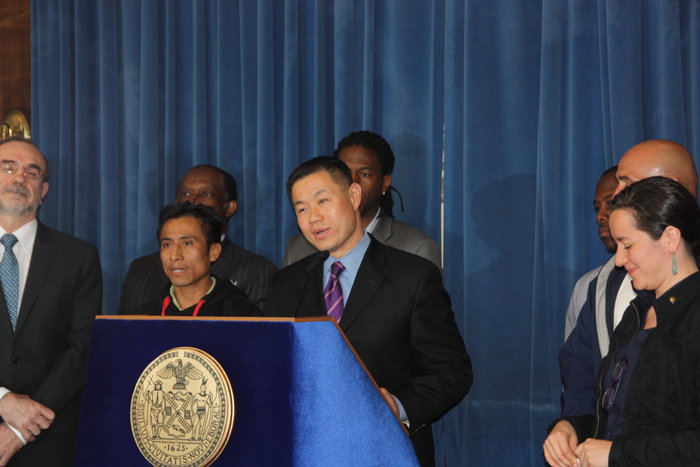
On the historic anniversary of Reverend Martin Luther King Jr.’s assassination on April 4, 1968, Comptroller John Liu announced a victory for immigrant workers in New York City.
After what he called a long investigation, Mascon Restoration, a College Point-based construction company operating in four Manhattan sites under a Department of Housing Preservation and Development contract, was ordered to pay a $1.2 million settlement for unpaid wages and benefits to its workers.
The company pled guilty to a felony charge for falsifying salary documents and failing to pay prevailing wages. It must also pay $75,000 to the Manhattan District Attorney’s office for the cost of the investigation and prosecution, and $243,880 to the state Labor Department for underpayment of unemployment insurance.
Except for $107,120 of the $1.2 million settlement, which is owed to the city for a civil penalty, the rest of the money is available for other workers who file claims of unfair wages.
At a press conference announcing the settlement last Thursday, Liu stressed that workers are covered under state labor laws regardless of their citizenship status.
“We know that immigrants are often afraid to talk with government officials, but it is important that we get the word out,” Liu said, adding that 46 percent of the city’s workforce is foreign-born. “We are encouraging these workers to come forward and claim their unpaid wages.
“The intimidation or exploitation of workers, immigrant or otherwise, will not be tolerated,” he said.
According to Liu’s office, workers at Mascon were paid $60 to $70 a day, although most were entitled to $150 a day plus benefits, and those working on high beams were owed $700 a day plus benefits.
The investigation was launched after three workers at a Mascon construction site acquired a publication from the comptroller’s office educating them on appropriate wages for their work, and requesting that those being mistreated come forward.
A representative from Liu’s office said employers are asked to post the publication around their work sites, but most do not.
One worker, who chose to go by the name Lanssay, immigrated from West Africa in 1989, and was available for an interview off-camera, through an English translator.
Lanssay, who worked in demolition at a Mascon site, said he received the flyer from the comptroller’s office, “and at that time they were given information and proof that they were not paid a proper salary that was by law what they should be paid.”
He and two other workers summoned the bravery to file a claim with the comptroller’s office when they heard that they could be paid the money they were owed, Lanssay said through the translator.
When he asked his employer to pay him the prevailing wage, his boss refused, the worker said.
“It happened in other places before, but they were not given the opportunity to give the proof and get compensation,” the translator said, when Lanssay was asked if he was exploited by previous employers. “That’s why they’re here.”
According to Liu’s office, after six years the money from the $1.2 million that is not claimed by workers will be put in the city’s general fund.
Councilman Jumaane Williams of Brooklyn said that in addition to encouraging exploited workers, legal and illegal, to come forward, the settlement should send a message to employers across the city.
“I hope it reverberates to everyone who is hiring [from the] immigrant population and think that they can exploit them without anything happening to them,” Williams said. “Let it be known that we are watching and we’re going to use whatever tools we have under our belt to make sure that doesn’t happen.”

To file a wage claim with the comptroller’s office, call (212) 669-4443. All calls are confidential.

Battle over fluoride returns

The dispute over fluoride will continue for another year, with Councilman Peter Vallone, Jr. hosting a day of activities at City Hall on May 15 to announce the introduction of legislation to ban adding the chemical to the city’s drinking water.
Fluoride was added to the city’s drinking water at a level between .7 and 1.2 milligrams per liter In 1962. A state law was passed in recent years, however, that gave local jurisdictions in New York the ability to decide whether to keep the chemical.
In January 2011, the Centers for Disease Control (CDC) recommended lowering the levels of fluoride in drinking water closer to .7, as it was reported that two in five children in America show signs of fluorosis, which involves mild to moderate white spots on their teeth.
Vallone, who represents Astoria, said he is introducing legislation to ban fluoride because the city should not self-medicate its residents.
He recommended those who are concerned about fluoride poisoning purchase water filters for their faucets.
“I have serious questions with using the water supply to force-medicate,” Vallone said in a recent interview. “What’s next, once you set this precedent that the government can decide what’s good for you?
“Maybe they’ll decide we’re not happy enough, let’s put some Xanex in the water,” he said, referring to an anti-anxiety prescription medication.
However, Vallone’s good friend Councilman James Gennaro, who represents Forest Hills, Rego Park and Kew Gardens, disagrees with his proposal.
After singing Vallone’s praises for being an environmental, public safety and animal rights activist, Gennaro said his Western Queens colleague is misguided by false science.
Lobbyists against fluoride “engage in a lot of scare tactics that are scientifically baseless,” Gennaro said, adding that “water fluoridation is one of the top 10 health advances of the 20th Century.”
However, Gennaro said city residents should not ask advice regarding fluoride from elected officials, but rather from medical professionals whom they trust.
New York City spends roughly $25 million per year adding fluoride to its water, according to the Department of Health.
In addition, according to a 1990 published study “Fluoride: Benefits and Risks of Exposure,” the chemical can be harmful to kidney patients, diabetics and those with fluoride hyper-sensitivity, even at levels deemed safe by the CDC.
But Gennaro said such findings are not backed by actual science.
Dr. Mark Wolff, associate dean of pre-doctoral education and chair and professor at the Department of Cariology, the study of decay, and Comprehensive Care at New York University, agreed that the use of fluoride is one of the largest public health victories for children and the elderly, who are most susceptible to tooth decay. He added that it therefore also has a monetary benefit in public health.
“There’s a laundry list of ‘what if’s’,” Wolff said, stating that fluoride has been blamed for numerous health problems, including the growth of tumors and the development of autism. “Every study has come back and said there’s just no evidence of risk to the public.
“What we do know is that children, geriatrics,” and other at-risk populations, “all reduce the number of cavities they’re going to get because they drink fluoridated water.”
However, he agreed that the CDC lowered its recommended fluoride dose because of the rise in fluorosis among children, which occurs because they consume fluoride from other substances, including toothpaste.
But Wolff said fluorisis is a greater risk for residents in southern states, where they consume more water due to the heat.
In summation, as a medical professional, Wolff said the benefits he’s seen from fluoride in drinking water in reducing tooth decay are massive.
“If we take fluoride out of the water in New York City, dentists will be busier in the next decade,” he said.
To further the discussion, Vallone will host a rally on the steps of City Hall at 11 a.m. on May 15.
Later in the day, at 1 p.m., he will announce a proclamation honoring P.S. 122 teacher Rebecca Victoros for her efforts in leading her students through scientific research projects in her program Project Citizen.
Recently, students in Project Citizen studied the effects of fluoride in drinking water, and will stand with Vallone when he announces his legislation at City Hall, a representative from his office said.

Project buzzing to boost local economies

Chase Emmons has a dream to build New York City’s largest commercial apiary, comprised of roughly two million bees that are genetically suited to endure New York City’s diverse climate.
Emmons is chief beekeeper and director of business development at Brooklyn Grange, a rooftop farm that recently expanded from its Long Island City location to a space in the Brooklyn Navy Yard, where the apiary will be kept.
The apiary will consist of 30 hives with roughly 50,000 bees per hive.
“Over the next two years we want to cross-breed bees that show themselves to be successful in the Yard and ultimately end up with a strain of bees that are really well-suited to the New York City environment,” Emmons said.
To fund the program, Emmons launched an online Kickstarter campaign, where he must raise $20,000 by Thursday, April 19, at 4 p.m. to receive the money pledged.
In return, Emmons said the apiary will have numerous benefits for New York City residents.
In addition to adding 50 pounds of honey per hive every season to the city’s local produce market, residents will be able to purchase their own genetically equipped Brooklyn Grange Bees, keep their own hives, and sell their own honey.
Local honey sells in the city for about $40 a pound, Emmons said.
Currently, city beekeepers purchase their bees from southern states. The bees are shipped in lunch-box sized containers through regular mail, which weakens them, at roughly $100 a box.
“There will be a new New York City local product, which can then be sold amongst New Yorkers,” Emmons said. “People can create their own little businesses with New York City bees.”
In addition to boosting the local economy, the apiary will be educational, with a pay-it-forward internship program the Grange launched in recent weeks.
In the program, interns will work with the bees until the season ends, near the end of September, when they will receive a batch of their own bees in exchange for committing to training new interns the next summer.
Twelve interns were chosen for this summer’s program, with a leftover waiting list of 50 from about 175 original applicants.
To give those on the waiting list a chance to participate, the Grange will host group-activity days throughout the summer.
“We want to involve as many of them as we can,” Emmons said.
The project also has an artistic element, as it is common to decorate hives so bees can recognize their homes.
“Bees navigate very visually like we do,” Emmons explained. “They can drift between hives and you don’t necessarily want that.”
To help the bees, the Grange is working with Visionaire magazine to bring in professional artists, including local urbanites and others flying in from as far as Brazil, to decorate the hives.
To celebrate, Visionaire will also host a black tie event at the Grange later in the summer, Emmons said.

For more information on the Grange, visit Brooklyngrangefarm.com, or to donate visit the Kickstarter page .

104th Precinct Blotter (4/2/12-4/8/12)

Monday, Apr. 2

Felix Rosario was arrested at 1859 Madison Street for petit larceny by Officer Gianesses.
Jesus Muniz was arrested at Palmetto Street and Cypress Avenue for robbery by Detective Webb.
Christopher Barbara was arrested at 2012 Harman Street for criminal contempt by Officer Gomez.
Victor Ortiz was arrested at 64-28 Madison Street for criminal contempt by Officer Gomez.
Saul Irizarry was arrested at Madison Street and Fresh Pond Road for assault by Detective Spagnola.
Ivan Delgado was arrested at 54-38 60th Road for criminal contempt by Officer Berke.
Sigfredo Davila was arrested at 69th Street and Myrtle Avenue for disorderly conduct by Officer Rogers.
Akim Martin was arrested at Eldert Street and Wyckoff Avenue for unlicensed operation of a vehicle by Officer Day.

Tuesday, Apr. 3

Ralph Taylor was arrested at 82-15 Eliot Avenue for burglary by Detective Geis.
Arthur Winnicki was arrested at 201 Butler Avenue for assault by Detective Spignola.
Marie Citak was arrested at 68-27 62nd Street for criminal contempt by Officer Gomez.
Edward Black was arrested at 1642 Madison Street for forgery by Detective Chichory.

Wednesday, Apr. 4

Martine Vasco was arrested at 84-31 62nd Drive for criminal mischief by Detective Lundy.
Gustavo Taveras was arrested at Palmetto Street and Cypress Avenue for robbery by Detective Webb.
Denard Cartagena was arrested at 70-20 66th Street for assault by Officer Gomez.
Carl Esposito was arrested at 66-56 Forest Avenue for criminal contempt by Detective Geis.
David Rodrguez was arrested at 70-12 67th Place for aggravated harassment by Detective Ebron.
Tiana Scott was arrested at 66-26 Metropolitan Avenue for petit larceny by Officer Dilan.
Cezar Davca was arrested at Cornelia Street and Woodward Avenue for disorderly conduct by Officer Wright.
Maria Ortega was arrested at 853 Wyckoff Avenue for reckless endangerment by Officer Peart.
Christopher Leone was arrested at 69-18 79th Street for assault by Officer Aviles.
Matthew Burd was arrested at 69-32 Myrtle Avenue for criminal trespassing by Officer Sowden.

Thursday, Apr. 5

Jav Baginski was arrested at 61-17 Gates Avenue for criminal contempt by Officer Skorzewski.
Lydia Rodriguez was arrested at 66-26 Metropolitan Avenue for petit larceny by Officer Florio.
Jonathan Acosta was arrested at 62-76 60th Place for criminal possession of a forged instrument by Officer Christian.
Jose Melendez was arrested at Grandview Avenue and Stanhope Street for reckless endangerment by Officer Rodriguez.
Leonro Diolata was arrested at Grand Avenue and the Long Island Expressway for assault by Officer Jackson.

Friday, Apr. 6

Robert Drellana was arrested at 62nd Drive and Woodhaven Boulevard for driving while intoxicated by Officer Shariff.
Chris Jones was arrested at Juniper Boulevard South and 69th Lane for criminal possession of a weapon by Officer Ock.
Lucia Morales was arrested at 66-26 Metropolitan Avenue for criminal possession of stolen property by Officer Mendez.
Kevin May was arrested at 68-02 Myrtle Avenue for petit larceny by Officer Jackson.
Lee Cohen was arrested at 71-05 67th Place for criminal contempt by Officer Bazata.
Daniel Majewski was arrested at 60-17 56th Road for criminal trespassing by Officer Inga.
Steven Santiago was arrested at 1724 Putnam Avenue for assault by Officer Winter.
Adam Almodovar was arrested at Caldwell Avenue and 81st Street for assault by Officer Aviles.

Saturday, Apr. 7

Juan Cruz was arrested at 281 Saint Nicholas for criminal mischief by Officer Mays.
Robert Wittmer was arrested at Fresh Pond Road and 60th Drive for driving while intoxicated by Officer Krokondelas.
Eric Ramos was arrested at 74-17 Grand Avenue for criminal possession of stolen property by Officer Kerne.
Nabil Salameh was arrested at 69th Place and Central Avenue for aggravated unlicensed operation of a vehicle by Officer Mendoza.

Sunday, Apr. 8

Alfredo Rosa was arrested at 75-02 62nd Street for criminal mischief by Officer Toor.
Marcelo Sucuzhamay was arrested at 16-33A Hancock Street for assault by Officer Collins.
Edwin Garcia was arrested at 16-24 Hancock Street for assault by Officer Rogers.
Paul Sanabria was arrested at 63-11 83rd Street for assault by Officer Tudor.

Ridgewood makes last effort to save Grover Cleveland

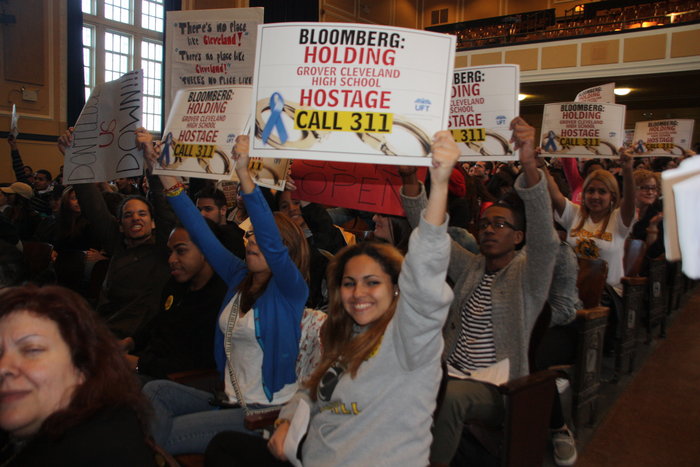
Students, staff and parents packed the auditorium in Grover Cleveland High School for a hearing on the future of the school on Monday, April 2.
Grover Cleveland is being considered for the “turnaround” method, which would give the building a new name and eliminate 50 percent of its staff come September. Schools are slated for turnaround when they’ve been on the state’s Persistently Low Achieving (PLA) list, meaning graduation rates were below 60 percent, for the last three years.
Currently, Grover Cleveland’s graduation rate is at 58 percent, 5 percent below the city average.
But speakers in the public comment period of the hearing said the school is not being considered fairly by the city.
The school, which started the 2011/12 school year under the federal restart model, got a new principal midway through September and therefore did not get the chance to prove its ability for success yet, they argued.
In addition, Grover Cleveland is one of nine test sites in the city for iZone – a program that lets students perform their studies any time, any where.
Students also work with the community, holding music concerts at a local senior center and hosting holiday events, such as a haunted house, speakers said, adding that if the turnaround method is implemented, the school could lose its plant science program, its music instruction and other services.
Alumni also attended the hearing, including Assemblywoman Cathy Nolan, class of 1976, and the Queens representative on the Panel for Educational Policy (PEP), Dmytro Fedkowskyj, who also graduated from Grover Cleveland, as did his mother.
Deputy Schools Chancellor Mark Sternberg stressed before the public comment period that the Education Department wants to help the school, not hurt it.
“It comes from a place of wanting to help our students,” he said of the turnaround proposal. “The structures and the staff that come with a new school can more quickly accelerate the pace of reform.”
In addition, he said, under the turnaround model, the school would receive upwards of $2 million in federal funding for reform programs.
But Nolan, who was wearing the school pin she saved from when she graduated Grover Cleveland, said she worked in Albany to help secure funding for the school under the restart model last year.
“I did not sponsor this so my high school could be closed,” she said.
In addition, Nolan added that the school operated under the restart model until the city struggled to reach an agreement over teacher evaluations, and then the turnaround model was proposed.
“I am deeply concerned about the effect this sudden change in course will have on the students at Grover Cleveland High School,” Nolan said. “Even just the announcement of the possible closing has probably done damage to the school’s future prospects.”
Master English as a Second Language (ESL) teacher Maria Rozos said the school’s graduation rates are low in part because many students don’t speak the language when they enter the school, and sometimes are illiterate in their native tongues.
She said it takes a second-language learner five to seven years to acquire academic-level English.
“However, the ESL students are held to the same standard as the mainstream native-English speakers and are expected to graduate in four years even though this goes against language theory and research,” Rozos said.
“As a school, we work tirelessly to prepare our ESL students for college and careers,” she added, citing multiple grants and programs the school received.
In addition, she said six out of seven of the last school valedictorians were did not speak English as their first language.
Selena Vasquez, a 10th grader at Grover Cleveland, said she and her peers want to go to college and get careers, which they are striving for under the instruction of their teachers.
“Many of the students that attend or have attended Grover Cleveland High School have formed great relationships with current staff and grown to trust them,” she said, giving examples of her favorite teachers.
“The staff in the school should not be penalized for something that is not their fault,” Vasquez added. “The teachers don’t have control over the students’ decisions and it’s the parents’ responsibility to make sure their child is going to school and passing.”
Further comments and questions about the proposal can be sent to D24proposals@schools.nyc.gov, and calls can be made to 212-374-7621. An analysis of the public comment and question-and-answer session at Monday’s hearing will be available online before the PEP votes on the proposal on April 26.

Swastika drawn on Grand Ave

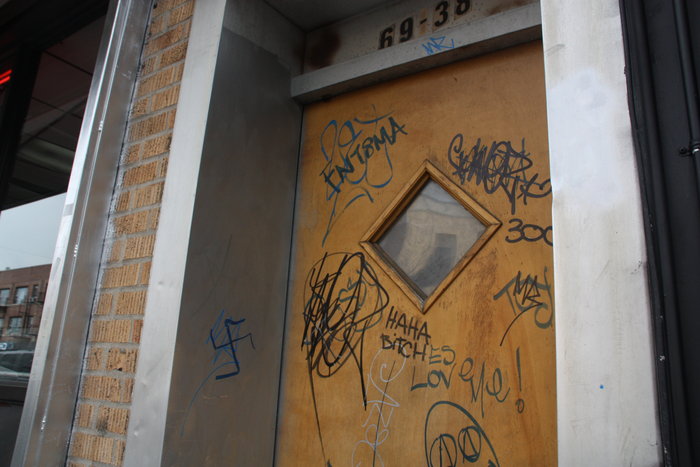
A swastika spray-painted on a building on Grand Avenue is just the latest incident in a rash of hate graffiti in the 104th Precinct.
A swastika appeared sometime before Wednesday morning on a metal door frame at 69-38 Grand Avenue.
When this newspaper brought the offensive symbol to the attention of Michael Terry, president of the Maspeth Chamber of Commerce, he said he’s noticed an unfortunate upswing in graffiti vandals in the area recently.
“It’s never a happy time to see anti-Semitic or racist symbols coming up,” he said, examining the graffiti drawn across the door.
Terry said he will bring the incident up at the next Chamber meeting, to be held on Tuesday, April 2nd at noon in Connolly’s Corner on Grand Avenue.
The swastika is drawn in blue paint marker over another tag, “MR,” which is written in dozens of places along Grand Avenue. In graffiti culture, it is an insult to draw over someone else’s tag.
Gary Giordano, district manager for Community Board 5, said the 104th Precinct has one of the highest graffiti arrest-rates in the city.
“But yet the vandals continue to do graffiti in this precinct where a lot of arrests are being made,” he said. “You would think that they would get the message.”
Giordano provided insight into why he thinks New York City’s graffiti epidemic persists – although he admitted that he does not know what is going through someone’s mind when they draw a swastika or other offensive symbol.
“I think that there’s some sort of unfortunate thrill with avoiding getting caught,” he said. “And I also think that some of it has to do with a lack of self-esteem and they can get a name for themselves by doing this and bragging about it.”
A representative from the 104th Precinct said officers responded to the location and saw the swastika along with an abundance of other graffiti.
The building owner was contacted and a report was generated, according to police.

Fill the Form for Events, Advertisement or Business Listing